
Tra Vinh prioritises developing sea-based economy, agriculture
The Mekong Delta province of Tra Vinh has been cooperating with the National Economics University (NEU) to implement its socio-economic development plan for 2021 – 2030, with focus on developing sea-based economy and agriculture.
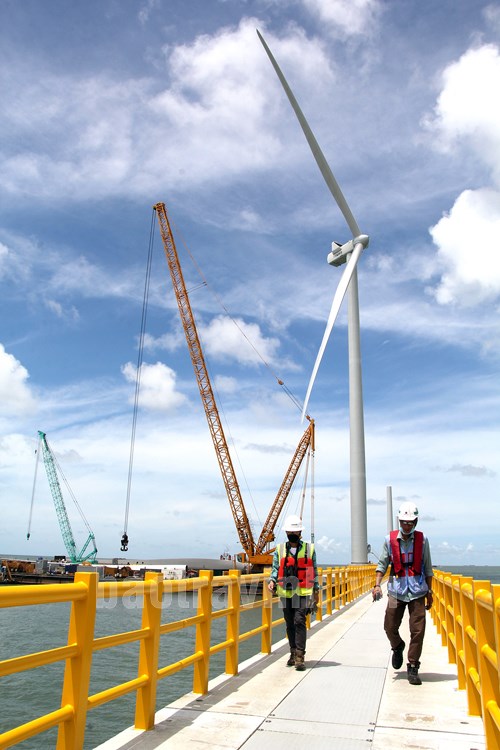
Illustrative image (Source: baotravinh.vn)
By 2030, Tra Vinh intends to cultivate rice on 195,000 hectares, mostly in freshwater zones in the districts of Cang Long, Cau Ke, Tieu Can and Chau Thanh. Annual output is expected to reach around 1.18 million tonnes, said Vice Chairman of the provincial People’s Committee Nguyen Quynh Thien.
The province will raise the area of low-yield rice and sugarcane farming converted to coconut farming to some 22,800 hectares which will yield over 327,000 tonnes per year.
Tra Vinh has huge potential to accelerate the growth of its sea-based economy as the coastal province is near Cai Cui Port in the neighbouring city of Can Tho, which is capable of accommodating large container ships.
It also has Dinh An Economic Zone, one of the country’s eight key coastal economic zones, that gathers firms in multiple areas, from industry, trade, services, to tourism, urban development, agriculture, forestry and fishery. The economic zone is prioritising projects in the areas of electricity production, petrochemicals, shipbuilding and supporting industries.
The province boats great advantages in developing aquatic farming with around 50,000 hectares of coastal land and 15,000 hectares of floodplains, alongside nearly 1,200 fishing ships. Additionally, it has been attracting renewable energy projects, with five out of eight wind power projects put into use.
Tra Vinh has what it takes to become a marine economic and clean energy hub of the Mekong Delta, said Assoc. Prof., Dr. Bui Huy Nhuong, NEU Deputy Director. It must develop the economy with help of advanced technology, he suggested, adding that agriculture, fishery, fruit and rice farming should be seen as a leverage to allow the province to make the most of its potential.
The province has also been urged to pay more attention to recovering and expanding local mangrove forests to provide new sources of livelihood for local people. It is aiming to expand coverage of mangrove forest to 4.2 percent by 2025 and 4.5 percent by 2030./.
https://en.vietnamplus.vn/
Related news
- Cooperatives Build a Better World: The 2025 International Year of Cooperatives theme
- China spends nearly US$400 million purchasing cassava from Vietnam
- Cashew exports in April hit record high
- Ample room remains for Vietnamese exports to Africa
- Vietnam becomes global production centre thanks to boom of foreign investment
- Roundtable calls for investment in agri-tourism real estate
- ASEAN consumes half of Vietnamese fertilizer exports
- Up to 551 million poultry heads raised for meat, eggs across Vietnam
- HCM City, Cuba partner in agricultural development
- Chinese traders to enter Vietnam for lychee purchase


